

Bring a quiet list back
Most of a small publisher’s email list has gone quiet: people who downloaded a free printable two summers ago and have not opened an email since. They already said yes once. A short, well-timed sequence can bring some of them back for the next book — and a careless one marks the sender as spam. This walkthrough follows a reactivation sequence rebuilt for the gift-buying weeks before the holidays.
- 01Discovery
- 02Leads
- 03Conversion
- 04Delivery
- 05Nurture
Bring lapsed subscribers back in the gift-buying window, with five emails that each lead to one obvious book.
What you can do
Section titled “What you can do”- Ask for a sequence against a goal and a window; the agent proposes the arc, the dates and the reasons.
- Read every email in the Workbench as the reader will see it.
- Answer the open questions by number, in one reply.
- Approve the send — or not. Sending to a list always waits for you.
The conversation
Section titled “The conversation”The spring reactivation emails never went out. Can we use them for the holidays?
email-sequenceNot as they are: the free gift they offer links to a page that no longer exists, and they never mention the Christmas book — the title this list is most likely to buy in December. I have rebuilt the five around it.
Sends run 18 November to 4 December, all before the shipping cut-offs, and skip Black Friday weekend, when a quiet sender loses to every retailer in the inbox. Email 1 comes in two versions to test.
Send email 1 in two halves, a day apart, most-engaged first?
What happens, and where you see it
Section titled “What happens, and where you see it”-
Read what exists — Workbench
The spring version is still there as version 1. The agent lists why it cannot go out as is, rather than rewriting from nothing.
-
Plan the arc — Workbench
Five emails over about two weeks: a reintroduction with a mystery to solve, the answer and the story behind the books, a gift guide by kind of child, the objection — my kid doesn’t like reading — answered with real reviews, and a last call before the shipping cut-off.
-
Write each email — Workbench
Each one leads to one book, with the product facts checked against the catalogue and every link pointing at a live listing.
-
Name what is open — Workbench
Numbered questions the owner can answer in one line each: which of two listings is live, whether to split the first send.
-
Hand off to the email tool — after your approval
On a yes, the agent loads the templates into the brand’s email tool and schedules them — and the schedule there is approved again before anything sends.
The real output
Section titled “The real output”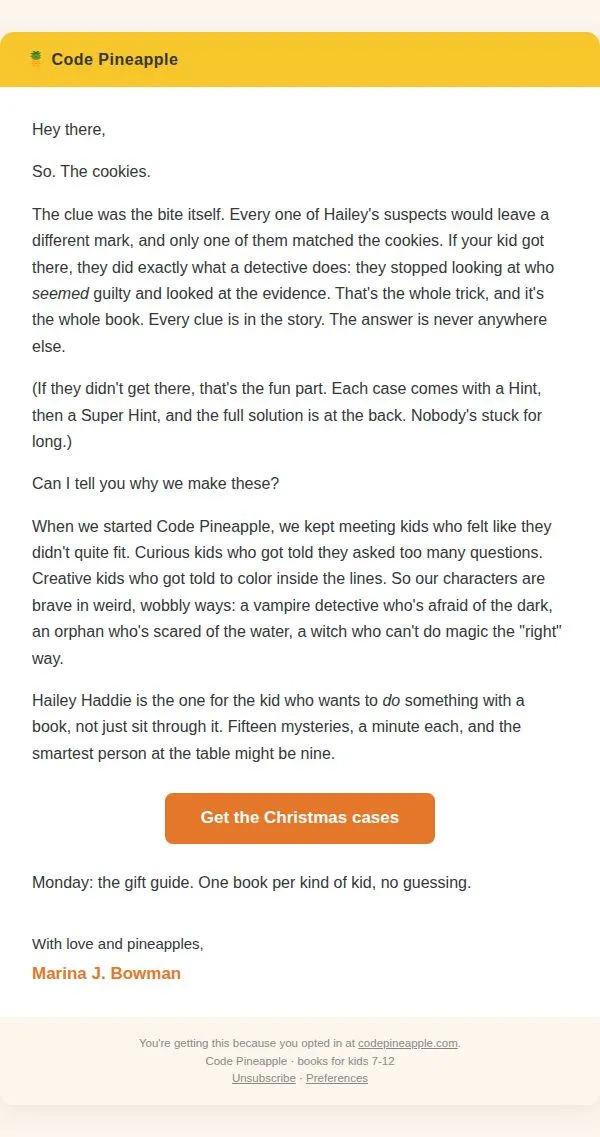
The sequence uses an open loop: email 1 ends on a case to solve, email 2 opens with the answer. A reader who tried to solve it has a reason to open the next one.
What to notice
Section titled “What to notice”- The agent said why the old version could not ship — a dead link and a missing book — before proposing a new one.
- The dates carry reasons, not just a calendar: shipping cut-offs, Black Friday noise, a two-half first send to protect a cold list.
- The send is yours. Writing is cheap and reversible; sending to a list is neither, so it stops twice.
Where it stands today
Section titled “Where it stands today”Writing and reviewing the sequence is available. Sending is Limited: it runs in your email tool after you approve. Details and evidence: What works today.
Related
Sources: brands/code-pineapple/pipeline/email-nurture (task record, three versions; the Q4 sequence), skills/email-sequence · Last verified 2026-10-06