

Writing the stories
The product is the book. In Hailey Haddie’s Minute Mysteries every story is a case the reader can solve from the clues on the page, followed by a hint, a super hint and the answer. A mystery that cheats — an answer that uses a fact the reader never saw — is the one thing the series cannot ship. This walkthrough shows how new cases are written and how they are tested before the owner reads them.
- 01Discovery
- 02Leads
- 03Conversion
- 04Delivery
- 05Nurture
Write new mysteries a nine-year-old can solve from the clues on the page — fair, funny and in the series voice — at the standard of the books already in print.
What you can do
Section titled “What you can do”- Ask for a batch of cases for a volume; the agent designs each mystery before writing it.
- Read only what passed — or read the gate record to see why something did not.
- Decide on the escalated cases yourself, with the specific weak point named.
The conversation
Section titled “The conversation”Next batch for the new volume, please. Mixed difficulty.
minute-mystery-writerFive cases, five different solution patterns, mixed tiers. Each one goes through the designer, the writer, and three test reads before you see it.
Batch done. Three accepted. Two escalated: in both, the test readers rated how well a child would grasp the key clue at 3 of 5, so a child might miss it. Every case passed the cold solve on the first attempt.
What happens, and where you see it
Section titled “What happens, and where you see it”-
Design the mystery — Workbench
A blueprint before any prose: the culprit, the one impossible thing they say, the clues and where each one appears, the red herrings and what clears them.
-
Write it — Workbench
The story in the series voice and at the series length, with the question, the hint, the super hint and the answer.
-
Gate A: the cold solve — in the background
A fresh reader gets only the story and the question — no hint, no answer, no blueprint — and must name the culprit by the intended reasoning. Each gate runs as a separate reader given only the pasted text, with instructions not to look anything up.
-
Gates B and C: fair play and craft — in the background
Every fact the answer uses must be on the page. Craft and delight are scored separately.
-
Accept or escalate — Workbench
A case that passes every gate goes to the owner to read. One that does not is either revised — with the specific change written down — or escalated with the reason.
A real gate record
Section titled “A real gate record”From batch 2, The Case of the Gingerbread Village. The first attempt passed the cold solve and failed fair play: the answer cleared one suspect using “the tray of breakages by the sink”, which appeared nowhere in the story.
The second attempt made three changes, all recorded:
- The tray was planted. A tray of broken gingerbread by the sink went into the description of the back of the room, unremarked — drawing attention to it would have handed the solver the answer, which is how two other stories in that batch failed their first attempt.
- The words were paid for. The paragraph describing the sealed room was trimmed from 50 words to 46, keeping all four facts that seal it.
- An anchor was added to a suspect’s line, so the timeline the answer relies on is on the page.
The second attempt was accepted. In the cold solve the test reader named the right culprit with 10 of 10 confidence, and the moment of certainty came two speeches before the detective’s final question — where the design put it.
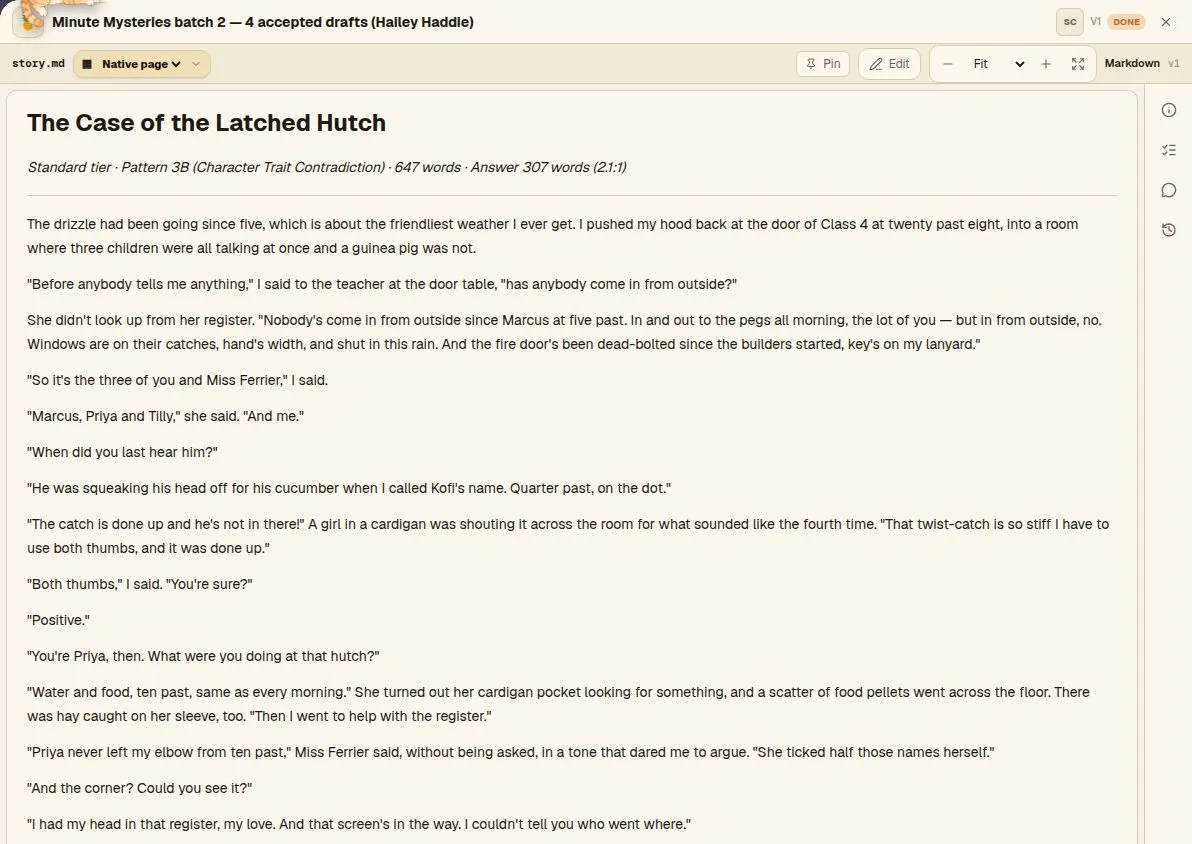
What to notice
Section titled “What to notice”- The test reader cannot cheat. It sees only what a child would see. That is what makes “it passed” mean something.
- Failure is specific. Not “the story is weak” but “this fact is used in the answer and is not on the page”.
- You read finished work. The escalations name what is wrong, so your time goes on judgement, not proofreading.
Where it stands today
Section titled “Where it stands today”Writing, testing and reviewing stories is available. The skill’s own improvement over these batches is in Improving a skill. Details and evidence: What works today.
Related
Sources: brands/code-pineapple/pipeline/minute-mystery-batch-2 (stories and gate records), brands/code-pineapple/pipeline/minute-mystery-batch-5 (task record), skills/minute-mystery-writer · Last verified 2026-10-06