Everything your agents know about you and your business, kept in one place, in a strict order of authority, with a source on every fact.
Tell it once. Most agent tools organise around a conversation. WilsonOS organises around a brand, and gives every brand a shared brain: its voice, customers, products and pages, plus the decisions, facts and results that affect it. That one choice is what lets an agent stay in voice without prompting, keeps two businesses from bleeding into each other, and means every conversation starts already knowing the business it serves.
What you do
Describe each brand once: what it sells, who buys and why, how it sounds and looks.
State your own rules — they outrank everything else.
Approve what gets promoted from private memory into a brand's shared lessons.
Connect the services whose numbers you want to steer by.
What your agent does
Loads the brand's essence every conversation, and the depth only when needed.
Records decisions and facts as they happen, scoped to you.
Looks things up before guessing, and says where a fact came from.
Keeps a provider's numbers as reported, and labels its own reading as judgement.
Each business you run is a brand, and so is the most important one: you. Every brand keeps its own essence, customers, voice, products and goals, and its own agent.
Your brands3 shown · pick one
Brand
What it is
Agent
C
Code Pineapple
Children's book imprint
Scout
R
RiseBlox
Agent systems and training
Prime
Y
You
Your personal brand
Mia
+Add a brand
Describe it once; every agent reads it
An onboarding conversation drafts the essence, the customer and the voice from what you say and what you already have.
You correct the draft. It becomes the brand stack below, loaded at the start of every conversation about that brand.
The brand gets its own agent, and nothing about it leaks into another brand.
C
Code Pineapple
Mystery, adventure and magic series for readers aged seven to twelve
businessbooksagent: Scout
Essence
Stories a child can solve, sold mostly on Amazon
Customer
Parents of six-to-ten-year-olds, in their own words: a phrase bank from real reviews
Voice
Playful, never cute for its own sake
Products
Series in print and in production, activity books, a free printable
Attributed from the connected store and ad accounts, each with its source
R
RiseBlox
Agent systems for businesses, and the training to build your own
businesstechnology and educationagent: Prime
Essence
Installs agent systems in client businesses; its teaching arm shows operators how to build them
Customer
Operators who want to replace manual work in their role with AI workflows and skills
Voice
A builder's register: plain, structured, practical
Products
Done-for-you installs, a builders community and skill packs
Y
You
Who you are, and who you are becoming
personalprivate to youagent: Mia
Essence
What you stand for and what you want to be known for
People
Family, friends, your professional network, and how you keep in touch
Voice
Yours, learned from what you write and what you correct
Goals
What you want to learn, build and practise; health and habits
Interests
The topics and news you choose to follow
Your personal brand is private to you. The personal area is Limited today; see What works today.
A labelled illustration of the idea, not the app's screen. Two real businesses and a personal brand; other businesses in the workspace are left out of these docs.
A brand carries its own brand stack:
Part
What it answers
Brand essence
The one-page identity: what it is, who it serves, how it sounds. Loads every conversation, so keep it short and link the depth off it.
Products and offers
What the brand sells, how it is packaged and priced, where it is sold.
Customer
Who buys and why, in their own words: the phrases they use, the problems they name, what moves them to buy.
Voice and visual rules
How the brand writes and looks, applied to every customer-facing output automatically.
Strategy
The current bets: which channels, audiences and messages.
Lessons
What has been learned from ratings, results and your corrections, added deliberately.
Each brand has exactly one agent, and this is a silo by design: Scout never carries RiseBlox’s context. Awareness across brands is Mia’s job, without loading every brand. Skills and workflows are shared by every brand; what makes the same workflow produce playful parent-facing copy for one and a builder’s register for the other is the brand stack it loads.
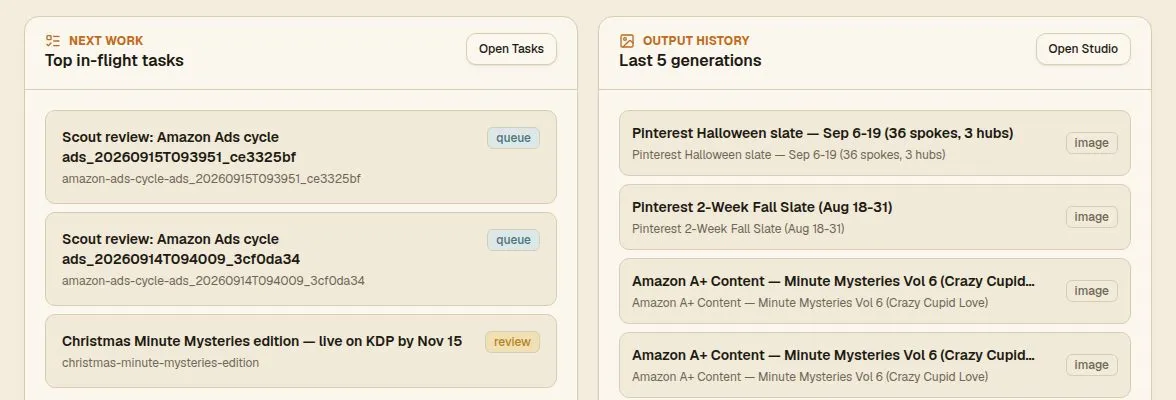
Screenshot from the Code Pineapple brand workspace: the next work and the last generations, each a link into the task or the Studio.
An agent’s knowledge comes from five separate libraries, and an earlier library wins on conflict, so it never has to guess which authority to follow.
#
Library
What is in it
Who writes it
1
You
Your role, preferences, working style and hard rules — “never X”, “always Y”
You, and Mia when you state a preference
2
Brand
Each brand’s stack, above
The brand’s agent, as the brand evolves
3
Capability
The skills and workflows themselves
Whoever writes or improves a skill
4
The system
How the platform works
The platform lane
5
Memory
The long tail: facts, decisions, events, corrections
Each agent, as it works
If a skill says “lead with the keyword” and the brand says “lead with the reader’s problem”, the brand wins. If a remembered fact contradicts a rule you stated about yourself, you win. And anything you can look up from current state — a skill’s instructions, a brand’s voice document — is not memory; memory is for what is not otherwise discoverable: a preference you expressed once, a decision made in conversation, a lesson from a result.
Memory has scopes, checked by trusted code on every read and write rather than by an instruction in a prompt.
Your memory with an agent — preferences, facts, decisions, a rolling summary — is readable by you, through that agent.
A conversation’s memory is readable by its participants and is never merged across conversations.
Brand knowledge is readable by everyone with access to the brand.
A private note never becomes shared brand knowledge on an agent’s judgement. The only path is promotion: Mia proposes an entry in the weekly review, you approve it, and the shared entry records where it came from. Nothing a scheduled run writes lands in a person’s private memory. The intended next step is brand-wide memory that anyone plugged into the brand can add to, every entry stamped with who added it.
Memory is written on purpose. Agents record decisions and facts as they happen, during and at the end of a task, through the sanctioned writers — not by anyone re-reading the chat afterwards. Overnight, recent events are distilled into a fresh summary and a ranked digest of facts. Those processes can only distil what was written, which is why “write it down now” is a rule, not a nicety.
A number is only useful if you know where it came from, how fresh it is, and what it cannot prove. Numbers from your connected services — the store’s advertising platform, royalty reports, Pinterest, web analytics — become a picture you can act on in four steps that never blur into each other.
Sources
what each provider said
kept exactly, with when and where it came from
Shared records
joined on real keys
only where an identifier connects them
Derived metrics
a stated formula
inputs named beside the number
Agent judgement
labelled as judgement
with its evidence and how sure it is
A labelled diagram, not a screenshot. Each step only reads the one before it; nothing is ever written back into a source.
Holiday activity book — Augustadvertising contribution · formula shown
Royalties — royalty report, monthly, per listing1,240 sourcerefreshed 2 Sep
Advertising spend — ad platform, daily, summed to the month and matched to the listing410 sourcerefreshed today
Advertising cost of royalties = spend ÷ royalties33% derived
Production cost, tools, labour, returnsnot connected
Profitnot computable — inputs missing
agent judgement Scout: “Contribution held while spend rose 18%; the two new keywords account for most of the rise and none of the added royalties. I would pause them for two weeks and watch. Confidence: moderate — one month, and returns are not connected.”
A contribution calculation — a labelled illustration with invented figures, not a screenshot. Currency omitted deliberately.
The rules it holds itself to:
Never change a source with a calculation. Once you edit what a provider reported, you can never reconstruct it.
Join only on a real key. Royalties and advertising connect because both carry the listing’s identifier; a social impression and a store purchase share none, so the gap is stated, not guessed.
Every derived metric names its inputs and formula. A number nobody can trace is a number nobody should act on.
Judgement is labelled as judgement, with its evidence and how sure it is.
No data is not zero. A metric with no feed says not wired yet; a stale source shows its age; a missing join says not yet measurable.
An incomplete calculation never gets a complete name. Royalties minus advertising is advertising contribution, never profit, because other costs are not connected.
Source
Reports
State
The store’s advertising platform
Campaigns, keywords, bids, spend, daily
Connected; refreshed nightly; the first engine runs on it
The royalty reporting service
Royalties by title, country, series
Read and reconciled against advertising; goals from actuals not built
Pinterest
Pin performance, outbound clicks
Connected
Video-platform research
Titles, outliers, keywords
Connected, for research
Web analytics for landing pages
Visits, sources
Not wired
Tracked destination links
Which page a visit or lead came from
Not built — the missing piece for any cross-channel funnel
Every surface reads the same records, which is what makes them one business rather than several apps: product (what the business makes or sells), offer (how it is packaged for a buyer), customer (a person or organisation the brand serves, before and after the sale), campaign (a coordinated effort aimed at an outcome), funnel stages and events (the intended progression, and the activity actually observed, each with a source), plus goals, tasks, versions and calendar entries. When Prime schedules a pin for a RiseBlox book, the product says what it promotes, the task tracks its making, the calendar schedules it, the connection publishes it and records the post’s identifier, and the engine measures it — one chain, no copies. A funnel stage is a definition observed events are matched against, never proof that one thing caused another. Every term is defined once in the glossary.
Stored versus loaded. Brand-shared knowledge (libraries 2–4) lives as documents, read-only to running agents. Private and conversation memory (library 5) lives in a database, where every row carries whose it is, which agent it belongs to, and for conversation memory which conversation. What is loaded is a separate question: a lean start-up bundle, then whatever a task declares.
Recall is structure first, search second. Each brand has a navigation manifest listing its documents with a one-line role; documents link to each other; a backlinks index shows what refers to what, so nobody writes a fifth document about something that already has four; keyword search covers tasks, skills, media, brands and memory, scoped to the searcher. Most retrieval in a good skill is not retrieval at all but a declaration, made once, of exactly what to read. A search with no person attached returns shared knowledge only, and says so. No matches is never treated as proof of absence: the agent checks the manifest or path before concluding something does not exist.
Why not vector search yet. It has real cost and maintenance — embedding, re-embedding on every edit, chunking choices — and on a wiki-shaped corpus with manifests and links its payoff is unproven. It will be added as a layer when keyword-plus-structure demonstrably fails on real work, not before.
One ingestion pattern. Every source is pulled by the same runner; what differs per service is an adapter with one interface: discover accounts, pull what is new since a timestamp, optionally backfill history. A service with no adapter is skipped and counted, not silently ignored. A connection that pulled once is a snapshot; only one with a registered schedule is a feed that supports a trend or an engine. A new source must declare the identifier it can be joined on, if any, and its refresh cadence, so freshness is judged rather than assumed.
The middle layer is a contract ahead of the code. Today’s derived numbers are computed inside the surfaces that show them; a named layer you can query on its own is not built yet. The contract is written first so that what gets built lands in the right place.
Related
AgentsWhat loads at the start of a conversation, and how it changes by setting.
Business analyticsChannel, funnel and business questions, and the limits between them.