

A free printable that builds the list
A parent who saves a pin is interested; a parent who gives you an email address can be reached again. The usual trade is a free resource worth more than the address. For a children’s publisher that is a printable — and it works only if a child actually wants to fill it in. This walkthrough shows how far the first draft was from that, and how it got there.
- 01Discovery
- 02Leads
- 03Conversion
- 04Delivery
- 05Nurture
Turn a parent's summer worry — screens, and the reading slide — into an email address, with a free reading challenge a child wants to fill in that points at the books.
What you can do
Section titled “What you can do”- Ask for a lead magnet against a goal; the agent proposes what it is and which books it promotes.
- Rate a version and say why, in your own words; the next version answers the note.
- Compare any two versions side by side, because none of them is overwritten.
- Get the landing page and the promotion plan from the same task.
The conversation
Section titled “The conversation”Three stars. This is a worksheet for a parent. A kid would never pick it up.
Understood — kid-first, then. I looked at what the best-selling reading printables have in common: a tracker the child colours in. Version 2 makes a bookshelf the hero page, one spine to colour per book, and keeps the calendar but with icons instead of text.
Better. The cover still looks like a wireframe.
Version 3 rebuilds it as an illustrated cover with the series characters, using the same recipe as the summer workbook you liked.
What happens, and where you see it
Section titled “What happens, and where you see it”-
Version 1: a worksheet — Workbench
Five pages: a cover, a note for parents, a 30-day grid, a reading log, and cards for the five series. Rated three stars: correct, and nothing a child would choose.
-
Version 2: kid-first — Workbench
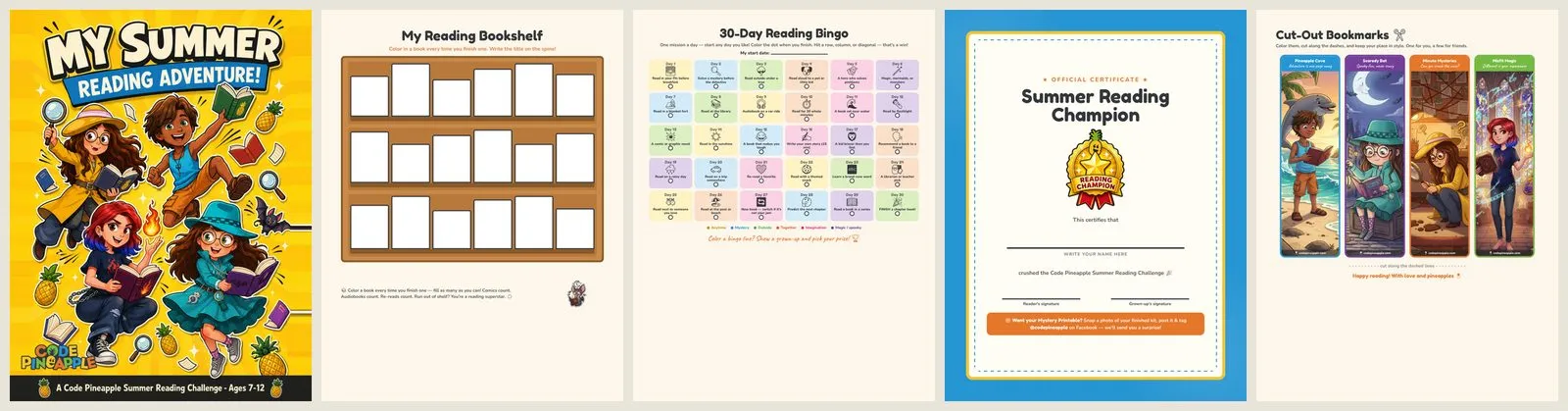
Nine pages built around a bookshelf the child colours in, one spine per finished book — the mechanic the best-selling printables share.
-
Versions 3 and 4: illustrated — Workbench
A character-led cover replaces the plain one, then moves from a storybook scene to activity-book energy: a flat brand-yellow field and characters mid-leap.
-
Versions 5 and 6: the bookmarks — Workbench
Each bookmark becomes a full scene from one series’ world. Then a sharp catch from the owner: the label belongs at the top, the part that peeks out of the book.
-
Version 7: final — Workbench
Logos off for now, labels centred, and the PDF compressed from about 13 MB to 2.3 MB so it downloads quickly on a phone.
-
The landing page — Workbench, then the email tool
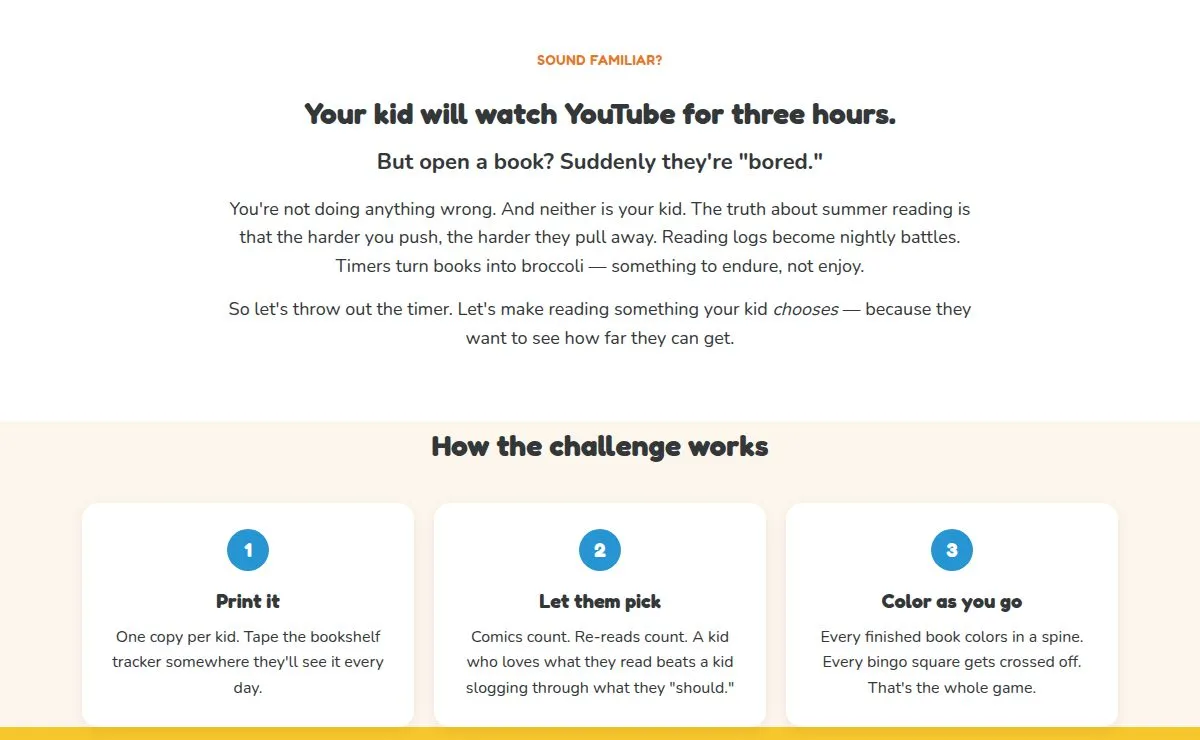
A page that names the worry in the parent’s own words and offers the printable. The email gate itself runs in the brand’s email tool.
The real outputs
Section titled “The real outputs”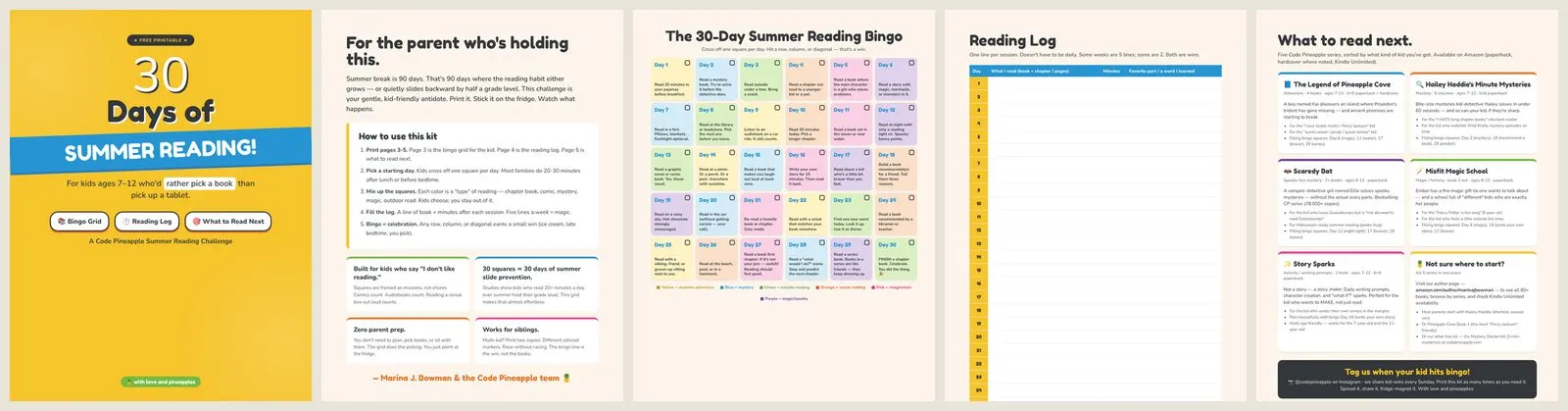
What to notice
Section titled “What to notice”- The first draft was allowed to be wrong. Version 1 shipped as a draft in minutes; the rating and one sentence of why did more than a long brief would have.
- The best note was about use, not looks. Moving the bookmark label to the part that shows came from imagining a child using it.
- It points at the funnel. Every page curates the brand’s own series as the next read, so the free thing leads to the paid one.
Where it stands today
Section titled “Where it stands today”Making and reviewing the printable and the page is available. Publishing a page is Limited — an agent-assisted step you review. Lead capture itself (the form, the address, the follow-up) runs in your email tool; capture inside WilsonOS is Planned. Details and evidence: What works today.
Related
Sources: brands/code-pineapple/pipeline/summer-reading-challenge-lead-magnet (task record, seven versions), brands/code-pineapple/pipeline/summer-reading-challenge-landing · Last verified 2026-10-06