

Research before you build
Every stage of the funnel is cheaper when you know where you can win. Before deciding which series gets the next trailer, the next A+ panels or the next book, it helps to know who each one competes with on the shelf, what those competitors do well, and what nobody is doing. This walkthrough is that question asked once, across the whole catalogue.
Know who each series competes with and where it can win, before deciding what to make next.
What you can do
Section titled “What you can do”- Ask a research question in plain words; the agent states the scope it will cover and the sources it will use.
- Read the report in the Workbench, and ask follow-up questions against it in chat.
- Correct an assumption; the correction is kept as a decision, not lost in the thread.
The conversation
Section titled “The conversation”Where does each of our series actually stand against the competition?
market research briefI will take all six series and, for each, the five closest competitors on Amazon: format, price, review volume, the keywords they rank for, strengths, weaknesses, and our edge.
Headline: Scaredy Bat is our strongest position — a kid-friendly vampire detective with few independent competitors. Misfit Magic School is the most exposed: one book against very large franchises, so growing it into a series is the critical move.
What happens, and where you see it
Section titled “What happens, and where you see it”-
Scope — Chat
Which series, which competitors, which dimensions, which sources. Agreed before the work starts.
-
Gather — in the background
Listings, categories and reviews from authorised sources; the brand’s own positioning and past research from the shared brain.
-
Write it up — Workbench
An executive summary first, then each series: genre, ages, catalogue, positioning, and the top five competitors in the same fields so they can be compared.
-
Decide — Chat
A report is an input, not a decision. You read it, the agent proposes what to do with it, and what you decide is recorded so the next conversation starts from it.
The real output
Section titled “The real output”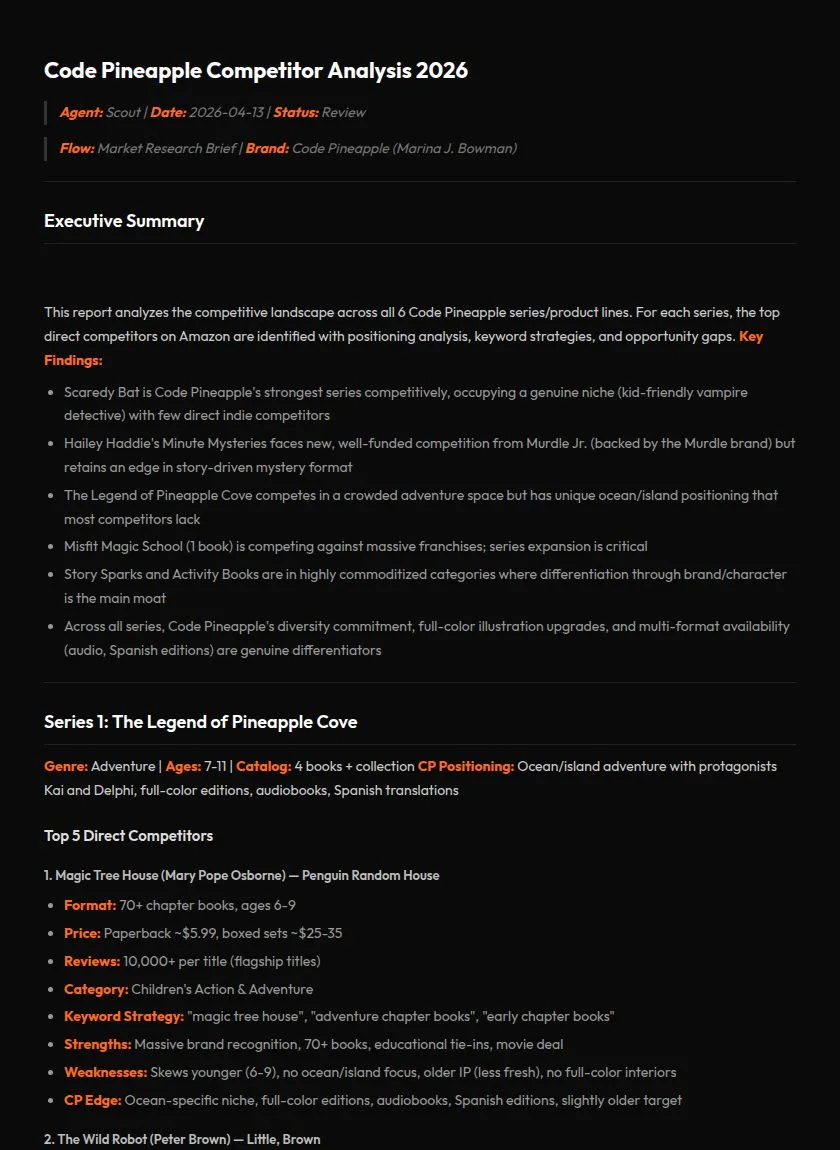
What to notice
Section titled “What to notice”- Every competitor is described in the same fields, so six series can be compared at a glance rather than read as six essays.
- The report ends at “our edge”, which is what turns research into a choice: what to make, and for whom.
- The finding is phrased as a decision you can take — “growing it into a series is the critical move” — not as a fact to file.
Where it stands today
Section titled “Where it stands today”Research flows and reports are available. Recording the decision you take from a report is part of the shared brain; details and evidence: What works today.
Related
Sources: brands/code-pineapple/pipeline/market-research-all-series (competitor analysis), flows/market-research-brief · Last verified 2026-10-06